


Kindergarten Literacy Centers for the First Week of School
It’s the first week of Literacy Centers! You’ve read all about Setting Up Successful Centers in my previous blog post, and you have your plan, but that’s only half the battle. Now you need to decide, ‘What are students actually going to do during these litereacy centers?’
It might be tempting to pull all the cutest activities you can find and let them have at it, but, trust me, in the first days, simple is best. You want activities that will teach students how to master routines, manage materials, and use tools correctly. We aren’t looking for rigor in the first weeks… we are looking for mastery of independence.

Before You Begin First Week Literacy Centers
Before you start any kind of literacy centers work, you MUST have some kind of plan and structure for setup. If you’ve jumped ahead to look at activities for the first week of school, that’s fine, but please make sure before you start that you’ve considered all the ‘behind the scenes’ prep that is necessary to make these literacy centers work.


Before Students Ever Visit Literacy Centers
One of the most common questions I get when I’m speaking about literacy centers at conferences with other teachers is “but how do you introduce the center so they know what to do when they get there?” It’s an important concern. You don’t want to send students to a center where they have had zero experience with the tools or materials. You are going to have to do some initial whole-group instruction.
So, for instance, as a group we are going to talk about and practice everything that is expected when you work with Play-Doh. I have a dedicated time that I introduce Play-Doh. We practice opening the containers and shutting them. I have Play-Doh mats that we learn to make ‘noodles’ and ‘roll balls’ on. It’s a whole thing, and students even get ‘certified’ to use Play-Doh. This sets them up for success when they are using Play-Doh at a literacy centers during the rest of the year.

I will do this same thing with every tool I plan to use those first weeks of school before students are expected to visit a literacy center. I am NOT in a hurry to start center rotations until each center has been introduced. I want to make sure that students have been taught materials and tools before I expect them to be independent, and I want them to have the opportunity to practice routines many times.

Before I Introduce Any Centers, My Students Know How To:
- Carry materials correctly
- Return materials to the correct place
- Clean up independently
- Work with a partner
- Use a quiet voice
- Ask for help appropriately
- Transition when given the signal to do so

You may think it ridiculous, but practice the simplest of tasks. We point before we go anywhere in those first days of school. It’s a lifesaver… trust me. As it is, you know it’s a little bit like organized chaos. You quickly find those students who struggle with two-step directions and are prone to ‘getting lost.’ Those are the little cherubs that you give little hints to until they catch on or buddy them up with a partner to keep them moving forward. It makes your head spin around a bit as a teacher, but you quickly learn just how good you are at multitasking.

Disclosure: As an Amazon Associate, I earn from qualifying purchases. If you purchase through one of the links below, I may earn a small commission at no additional cost to you. Thank you for supporting Differentiated Kindergarten!

What Literacy Centers Look Like During the First Week
Before I introduce the center activities I include in my classroom this first week of literacy centers, please remember, these are intentionally very simple tasks. They must be so that students can build stamina, practice expectations, and develop some confidence before rigor. Remember, success in these simple tasks will build independence. Many activities will focus on using familiar tools while students practice their names so that those tools can be used throughout the year for more challenging word work/reading activities. It may seem like it takes forever, but this pre-loading stage will save you HOURS in the long run.
I’m going to give you several ideas for your own centers, but remember, only pick one center activity at a time. Your students will not be ready for choices . . . yet!
| Literacy Center | First-Week Activity | Materials Students Learn to Use | What You Can Observe |
|---|---|---|---|
| Work on Writing | Following lines, fine motor, name writing | Dry erase pens, crayons, writing mats | Name writing, pencil grip, fine motor, hand-eye coordination |
| Listen to Reading | Listening to and following along with a story | Headphones, books, listening device | Listening behavior, book handling |
| Word Work 1 | Names and alphabet exploration | Magnetic letters, stamps, letter tiles, pattern blocks, Lego bricks, snap cubes | Letter recognition, name recognition |
| Read to Self | Exploring familiar books | Book boxes, classroom books | Book handling, stamina, interest |
| Meet the Teacher | Simple name, fine motor, or alphabet activity | Dry erase pens, fine motor tools, letter tools, cars | Letter knowledge, oral language, fine motor skills |
| Word Work 2 | Learning familiar games | Spinners, Jenga, pocket charts, cards | Game play, taking turns, oral language, some letter recognition |
Writing Center: First Week Activities
In the first weeks of school, our writing center may look more like a fine motor center than it does actual handwriting. As the years progress, we have seen a drastic reduction in the number of students who can actually hold a pencil properly with any kind of strength. So initial weeks of our writing center, while we are working on directional writing of lines and name writing, we also spend a good deal of time on fine motor skills. Students will learn about posture, pencil grip, paper orientation, and how to use specific writing tools.
I like to use these dry-erase mats to teach directionality and tracing on the first days. Dry-erase markers are more forgiving than pencils; they slide and clean up easily. Plus, little kids think they are cool.

As students’ readiness levels become more apparent, this station will become more differentiated, but the basic activities will be familiar, moving from writing names to letters and eventually to words and extending sentences.
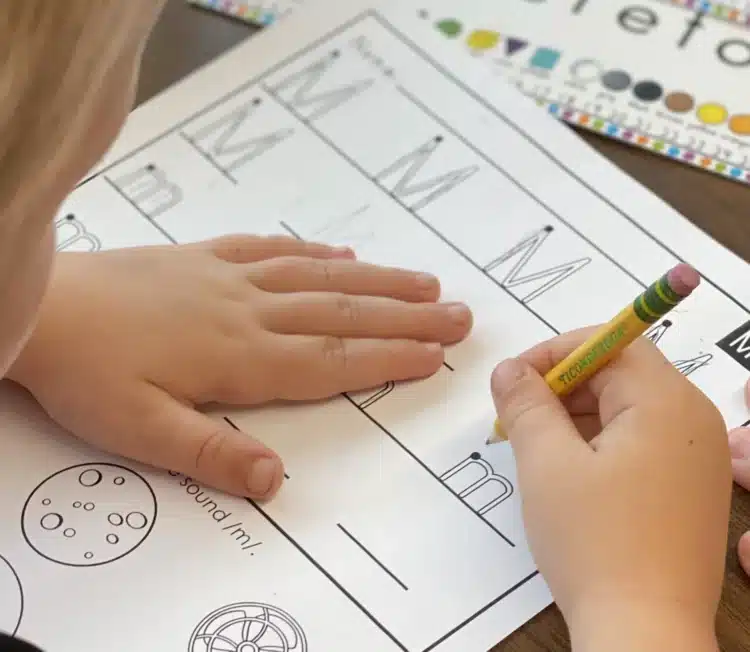
First Week Writing Activities Suggestions
| Activity | Student Task | First-Week Purpose |
|---|---|---|
| Pre-Writing Mats | Start at the dot and follow the line or shape using a dry-erase marker | Shows grip, directionality, hand-eye coordination, fine motor |
| Draw and Tell | Draw a picture of yourself and tell someone about it | Builds oral language, demonstrates body awareness and introduces writing routines |
| Name Writing Mats (Get them free on the linked blog post.) | Start at the dot and follow to write name using a dry-erase marker. | Shows fine motor skills and control and name recognition |
| Tool Practice | Use pencils, crayons, and paper correctly | Teaches material routines |

First Week Writing Center Materials:
- Dry-erase Markers
- Pre-Writing Tracing Mats
- Name Tracing Cards (Free on the linked blog post.)
- Plain paper, golf pencils, crayons
Listening Center: First Week Activities
Before students start this center, they will have already mastered using headphones, learning how to start and stop equipment, following along in a book, turning pages, where a good place to set is, and how to take care of materials.

I prefer that those first weeks of school are spent using individual CD players and books. I just like the idea of books in hands for kids. They can listen at their own pace without having to share with other students. Plus, I have literally 100s of books on CD.

As the year progresses, I will introduce iPads/Chromebooks as well for listening. My students love Epic and Vooks especially for listening. But interestingly enough, I find that when given the choice, my students tend to choose the books and CDs.
Teacher Tip: During the first several weeks of school, successfully using and returning equipment is enough. Later in the year, I will introduce response sheets to extend learning.
Listening Center First Week Materials:
- Headphones
- Books with CDs, Apps with Books for Listening (Epic, Vooks, etc.)
- Listening Device (Individual CD players, iPads, Chromebooks)
- Clearly labeled storage for each listening device

Word Work 1- Alphabet and High-Frequency Word Practice: First Week Activities
Although this center will eventually focus primarily on the Alphabet and High-Frequency Words, during this first week of activities, we only work on names. But by doing that, we can use the tools we practice on letters and words later. This is where we will practice using letter stamps, magnetic letters, Play-Doh, daubers, watercolor paints, and all kinds of necessary tools.

Name activities are great for those first couple of weeks until we start introducing letter sounds, but it really is perfect because then, by the time we do, students know how to use all the pattern blocks and legos and snap cube tools that we use during this center.

I can introduce how to use stickers during those first weeks, and by the time we are ready to start with letters, I don’t have to reteach how to use stickers appropriately. It makes things so much easier.

These center activities continue to be very hands-on throughout the year with letter production and then progressing to mapping words. Hands-on means students stay engaged and classroom management is so much easier.

Word Work 1 – Letters and Words First Week Center Ideas
| Activity | Materials | Skill Practiced |
|---|---|---|
| Build Your Name | Name card and magnetic letters | Name recognition and letter order |
| Stamp Your Name | Alphabet stamps and ink pad | Letter recognition and sequencing |
| Watercolor Names | Water color name sheets | Letter Recognition, beginning letter sounds, hand-eye coordination |
| Letter Building Mats | Letter mats using play-doh, stickers, pattern blocks, snapcubes or legos | Letter formation and hand strength |
| Torn Paper Names | Black onstruction paper, torn paper in bright colors, glue sticks | Hand-eye coordination, tearing paper, name recognition, how to use glue sticks |

Work Work 1-Letters and Words Materials Used During Week 1:
- magnetic letters with some inexpensive metal cookie sheets
- name cards
- letter stamps ( I like to keep mine in labeled icecube trays for simple organization!)
- water colors
- water color name sheets
- letter mats
- building tools for letter mats: pattern blocks, geoboards, stickers, snapcubes, Lego building bricks
- Construction paper and glue sticks
Read To Self: First Week Activities
Read to Self is a center that does not happen overnight. It takes practice in building stamina, knowing the expectations, and following directions the entire time. I find that because my early literacy center rotations are very short (maybe 5-10 minutes the first several weeks) students can build up their stamina naturally, but it can be difficult for some.

Use whole group instruction time to introduce book boxes, practice directionality, how to hold and care for books, turn pages, look at the pictures, and do all of that without disturbing the other students in the class.

I personally think that having dedicated book bins like these makes things easier because students grab and go. At the beginning of the year, I offer them a lot of board books and simple familiar stories. As the year progresses, they will get decodable books and still have the opportunity to choose some books based on their interest as well. If they want, on Fridays, they can ‘shop’ for new books, and that’s when I will update their decodable books as well.
Read To Self Materials for the First Week:
- board books (helpful when learning how to handle books)
- decodable texts
- books with familiar characters
- non-fiction books
- clearly labeled book bin for each child
- variety of areas for comfortable reading
- some kind of SitSpots or velcro dot that will help students identify good ‘listening’ spaces to use

Word Work 2 – Phonics and Phonemic Awareness Activities: First Week Activities
While this center will ‘eventually’ focus on phonics and phonemic awareness activities, these first weeks I like to use this center to once again practice tools and teach simple games we will use in the coming months.
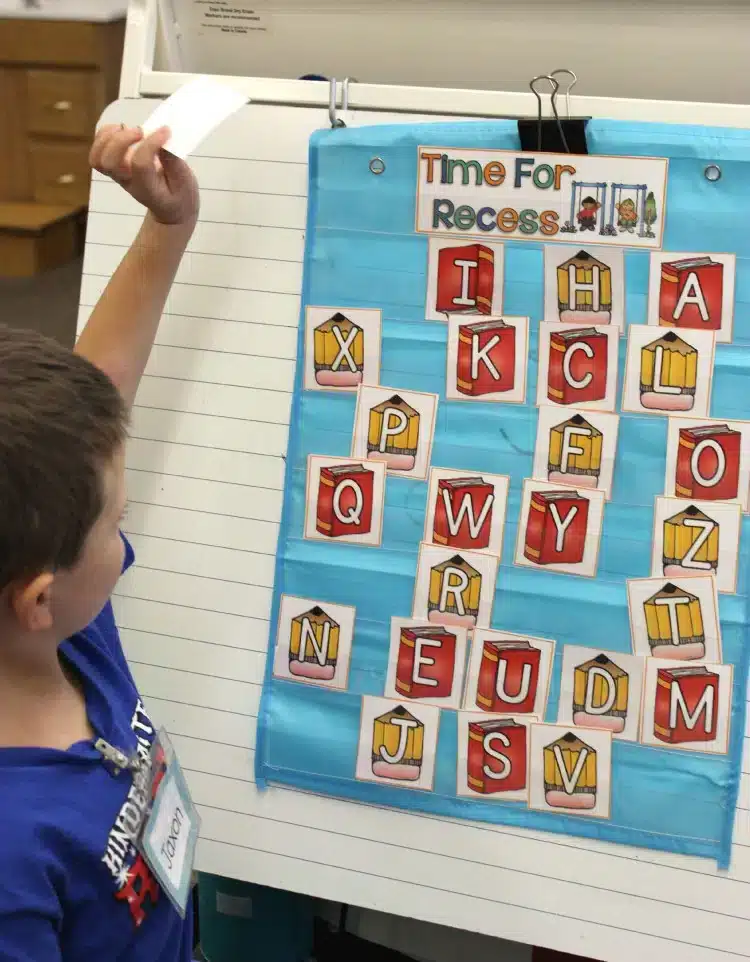
I can not teach these all at the same time, so I use these weeks to really get them so they know the rules and have mastered the games so that I can just change the skill or the theme and they will be able to play the game all year long. And yes, they like to play the same games over and over and over again. Games that are familiar to them help them feel successful. So pick a couple of games that can easily be differentiated, can grow throughout the year, and you are set.

Games my students love to play:
- Hide and Seek – can be used for any skill. You just need a set of cards and a smaller card to hide behind the cards. Students guess which card the item is hidden behind by naming a letter, sound, rhyme or whatever skill you are targeting.
- Yatta – Simple, highly engaging activity where students search a mat for a letter, sound or word (can be used for math as well). First student who finds the item, points to it and says ‘Yatta’ is the winner of that card.
- Jenga – Played like regular Jenga but students have to identify the letter, sound, or word on the Jenga block. If they identify it, they keep it. If not, it goes on the top.
- Dot-It 4 In A Row – This game is used with spinners. Students spin and whatever letter, sound or word it lands on, they dot their sheet. First person to dot 4 in a row is the winner.
- Spinner Games – Because students love using spinners, I have a ton more board games that we play with them.

Meet The Teach – Direct Small Group Instruction
During the first weeks of literacy centers, there is no direct small-group instruction. The reality is, they aren’t ready to be on their own yet. I am still managing literacy centers until they can prove to me they are ready to fly solo. It takes a couple of weeks for them to get there, so don’t get discouraged. It will happen. You have just got to be patient and hold the course.

Until then, my ‘Meet the Teach’ center is filled with independent activities they can complete with little to no direction from me. This ABC parking lot one is a favorite independent activity, and it’s FREE from my blog. I label cars using painter’s tape, and they match the cars to the corresponding labeled parking spot.
I also like to throw in some extra fine motor activities at this center during that first week too.

You can never go wrong with any fine motor activity. They need it so desperately those first weeks (and throughout the year). Pick a couple of your favorites to have available until you’re ready to start your direct instruction, small groups.

Meet The Teach Possible Activities for First Week
| Activity | Materials | Skill Practiced |
|---|---|---|
| Letter Parking Lot Activity | Letter Parking Lot Mat 26 cars with letters | Letter recognition |
| Pokey Pin Name Activity | Push-pins in erasers and pokey pin name sheets, construction paper | Letter recognition and fine motor, hand-eye coordination |
| Sorting Letter Activity By Physical Attributes | Small, talls and falls sorting mat | Visual discrimination |
| In My Name Not in My Name | Cars with letters, sorting mat | Recognizing letters in their name and not |
| Letter matching activities | Letter matching dinosaurs, llamas and alligators include an alphabet sheet for reference if needed | Matching capital to lowercase letters |
As your literacy centers become more independent and they start needing you less, this center can also be used for some initial assessing. You NEED this to pinpoint your students’ level of readiness. This will make it possible for you to differentiate quickly and easily.

I like to use ESGI assessment software because it’s quick, easy, saves me time, and gives me data instantly. You can sign up for a free trial right now.

Meet The Teach Materials For The First Week:
- Cars with letter labels (I used frog tape.)
- Letter Parking Lot mats
- Pokey Pin Name Sheets
- Pushpins and eraser for parking
- Letter Matching Activities (dinosaurs, llamas or alligators)
- In my name/Not in my name sorting mats
- Sorting Letters (Talls/Smalls/Falls) Mat and magnetic letters
What I DON’T Put In Literacy Centers the First Week
I’ve learned over the last many years that some activities are simply too much for little folks during that first week of literacy centers. Things you won’t find in my center drawers during these first weeks are worksheets, complicated games, anything that takes a lot of steps to complete, and anything that hasn’t been introduced or taught. Also remember, you don’t want to offer too many choices during this initial honeymoon period of literacy centers.
Don’t get me wrong, they need choices. However, maybe the choice is where to do the activity or who to do it with rather than a bunch of activities in a drawer. Only start adding additional activities once one has been mastered. Also, take your time . . . take it slow . . . go back and review and practice things when they fall apart.

First Week Reality Check
Listen, everything is not going to go perfectly those first days of literacy centers. Don’t get frustrated. As a group, I like to bring the students together and ask them what went well and what didn’t. They will say things like “we were too noisy’ or ‘tools got put back wrong.’ Make a list so they know their feedback is important to you. Make sure you also make a list of the things that went well. Make your literacy centers successful should be a group effort.
In the end, whatever seems to be causing you issues, make sure you revisit those routines and expectations, model behavior and practice them over and over. This is a work in progress . . . progress being the key.

For More Help With Kindergarten Literacy Centers
If you’re looking for more information to help you with your literacy centers and literacy instruction and centers, check out these related posts. Just click the post from the ‘Read This Next’ column to learn more.
| Need Help With… | Read This Next |
|---|---|
| Routines, rotations, and organization | Effortless Kindergarten Literacy Centers |
| Name practice | Name Writing Activities |
| Fine motor preparation | Fine Motor Home Kits |
| Handwriting support | Handwriting Activities |
| Morning independence | Morning Work Bins |
| Daily classroom scheduling | Kindergarten Daily Schedule |

Share This:

Marsha Moffit McGuire
With more than 20 years of teaching experience, it is my pleasure to bring you my most favorite ideas and activities to keep young learners engaged and loving learning.


Leave a Reply