


How to Set Up Morning Work Bins in Kindergarten: A Step-by-Step Guide
Kindergarten mornings can go from calm to chaos in about thirty seconds. Students are coming in hungry, tired, excited, sad, chatty, wiggly, missing their dog, needing the bathroom, needing help with backpacks, and somehow you are still supposed to take attendance, collect notes, answer questions, manage breakfast, and start the day like a calm, organized professional.
That is exactly why I love using morning work bins in kindergarten.
Morning work bins give students something meaningful, hands-on, and independent to do when they arrive each morning. They aren’t just cute tubs of random stuff. When they’re planned well, morning work bins can help students build fine motor skills, practice early literacy and math concepts, learn classroom routines, work with a partner, and settle into the day without another worksheet sitting on the table.
Why Morning Work Bins Work So Well in Kindergarten
The reasons why you should consider using morning work bins in your classroom are numerous, but let me just share why I started using them so long ago. Back when I started in kindergarten, I had this naive idea that my students would arrive at school each morning, well-rested, fed, and ready to start the day.
They would all march into my classroom, remove their things, and get right to their seats, where they would quietly complete a standards-based worksheet while I would have time to collect lunch money and notes from home and take attendance or attend to whatever else needed to be addressed at that time. But after teaching kindergarten for about 5 minutes, I understood very quickly that my idea was a big fat fantasy.
Instead of compliant kindergartners, I had students wandering in from the playground, one was crying because they missed their dog, 3 were hungry, 2 had shoes that needed to be tied, and they all needed to go to the bathroom, but there was only one potty. Of the ones that had made it to a table and found the ‘engaging worksheet,’ one had decided to scribble over the top of it, one had taken the scissors and was cutting it into little pieces, and 4 thought it was too easy and had found the items from my ‘inside recess’ tubs and were making their own fun.
I still hadn’t taken attendance, there was a lunch count that needed to be turned in, notes from parents to be read, and 2 sweet babies that just weren’t able to hold it and now needed a change of clothing! The face below could be the poster child for that morning! I hated mornings, my students hated mornings, and I knew that something had to change.

So instead of boring mornings, mornings now look more like the picture below. Students are dispersed throughout the classroom, working with other students on engaging, fun activities that are focused on fine motor skills, but that also address essential skills. It isn’t FLUFF. It isn’t ‘just play.’ It’s meaningful and important kindergarten work, and it is all because of Morning Work Bins in Kindergarten.

Quick Start: How I Set Up Morning Work Bins
| Step | What to Decide |
|---|---|
| 1 | How many days a week you will use morning work bins |
| 2 | How many students will work at each bin |
| 3 | How many activities you need for the month |
| 4 | Where bins will be stored |
| 5 | How students will know which bin to use |
| 6 | How long morning work will last |
| 7 | What materials students can manage independently |
| 8 | How often activities will be rotated |
The Benefits of Morning Work Bins In Kindergarten
Implementing morning work bins in kindergarten into my daily routine has changed and made my teaching life infinitely better. My students come to class excited to see what they will be using in their bins that day. They come in quickly and take care of their things. Then they can grab breakfast if they need it, and use the bathroom at their convenience. As they use the engaging morning work bin activities, they are actively moving about the classroom, choosing a comfortable place to work, and engaging with their peers. All that chit-chat and those wiggles are getting taken care of before I start whole group instruction.

But more importantly, morning work in my classroom keeps students engaged in activities that promote fine motor development. And, it does it while focusing on essential skills for kindergarten. These stations build student confidence, and my kindergarten friends feel successful.
Decide What You Want Morning Work Bins to Do
Of course, your morning work bins and activities do not have to look exactly like mine. You may have different goals and a different vision of what you want your bins and this time of day look like. That’s ok. Just make sure you take some time to jot down what you are looking to gain from morning work. I am happy to share what I came up with for my own classroom. When I thought about morning work, this is what my wish list looked like . . .

How to Plan Your Morning Work Bin System
Before you start buying bins or printing activities, take a minute to think through how morning work will actually run in your classroom. The activities matter, but the system matters even more. A simple plan for storage, partners, timing, rotations, and clean-up will make the difference between morning work bins that run independently and morning work bins that become one more thing for you to manage.

How Many Morning Work Bin Activities Do You Need?
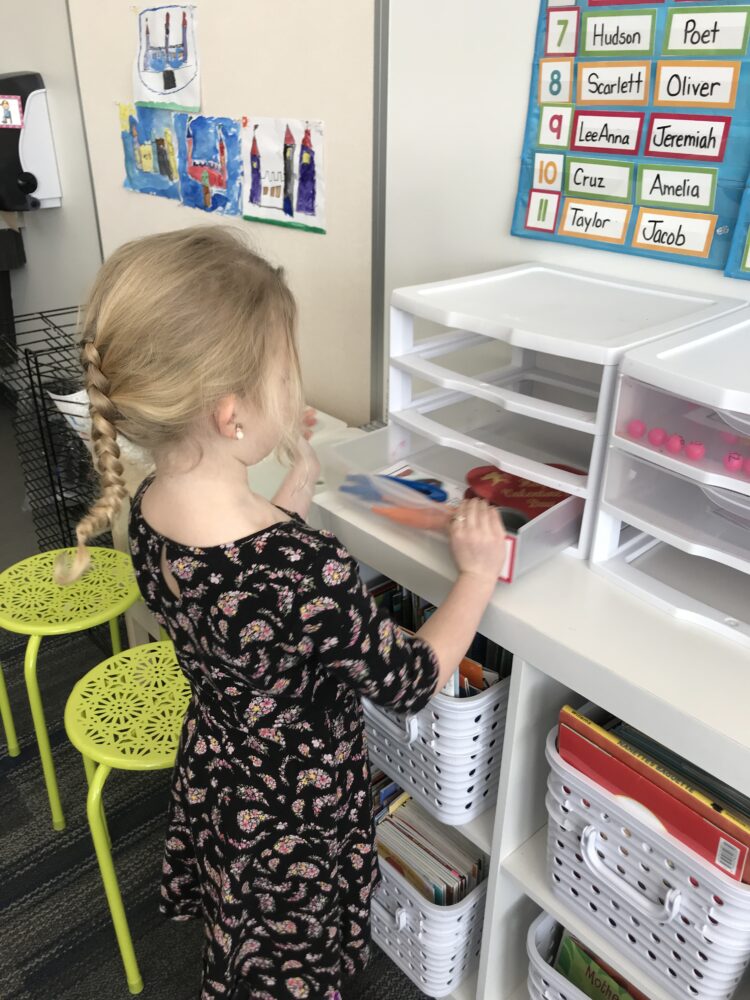
For my classroom, I planned on using morning work bins four times a week, leaving Friday morning for computer work. That means that in a given month, I would usually need somewhere between 12 to 16 morning work bin activities. Students would only attend each bin once in a given month. At the end of the month, bin activities would change.
This would mean I would need a system that could hold at least 12 bin activities, with the possibility of adding more. I chose this 12-drawer system and use the bottom shelves to house extra activities in separate totes if needed. This drawer system has lasted for over 10 years and has been very easy for students to manage.
How Many Students Should Work at Each Bin?
These morning work activities are not meant to be done in silence. I want my students to be able to have conversations with their partners. This time is perfect for visiting and sharing with their peers. It gets it out of their system so that when it’s time to learn, they are ready to listen.
However, I find that when there are more than two students at a station, the noise level can get out of hand. By keeping two students per bin, students can spread out around my room, and the noise level is very manageable.

Choosing partners to work together is a bit of a work of art. I typically like to place students together who might not normally choose to be together. I find this helps build new relationships with my students. Being partnered with different students exposes them to new friends they may not have met yet. Students keep their same partner for the entire month and then I switch them up. When students come into class in the morning, they simply walk to the morning work bin pocket chart, locate their name, and find the corresponding numbered drawer. At the end of the day, these numbers move down.

How Long Should Morning Work Bins Take?
When I first started offering Morning Work in my classroom, these activities would last between 15 to 20 minutes. But a few years into it, ‘breakfast in the classroom’ was introduced in our classrooms. I thought this was going to make morning work impossible, but I just needed to make some minor adjustments. First of all, I try to have two dedicated tables for my breakfast eaters. Because my students were anxious to get to their bins, they don’t tend to dawdle at breakfast. They quickly eat and get to their bins. So now morning work and breakfast together last around 20-25 minutes.

How To Make Morning Work Bins Independent!
The whole goal of morning work bins is to create activities that would give my students extra practice in essential skills. But I also needed to be able to complete the necessary chores of a teacher’s morning. If I have to manage materials and bins, that defeats one of the main goals of morning work. So setting up these bins so that they can be managed by students independently is a must. That means that the bins or drawers need to be located in a place where they are accessible to students. It also means teaching students how to select appropriate areas to work.

You should plan on spending time modeling and practicing what your expectations are for different materials that students will use throughout the year. This time spent during the first weeks of school teaching students how to find their name and their corresponding bins as well as managing materials, will be invaluable and make morning work your favorite time of the day, too.
What To Put In Your Morning Work Bins
What you put in your morning work bins really depends on what you want those bins to do. For me, I want activities that give students practice with important early learning skills while also building fine motor strength, independence, and problem-solving. I’ve listed some of my favorite types of activities below, but if you want to see exactly how this looks in my own classroom, definitely check out my monthly Morning Work Bins blog posts for more ideas and examples.
| Bin Activity Type | Skills Students Practice |
|---|---|
| Fine motor tools | hand strength, grip, coordination |
| Building materials | problem-solving, spatial reasoning, cooperation |
| Play dough activities | squeezing, rolling, pinching, letter/number practice |
| Sorting activities | visual discrimination, classification, vocabulary |
| Patterning activities | math thinking, sequencing, color/shape recognition |
| Counting activities | number sense, one-to-one correspondence |
| Letter activities | alphabet recognition, beginning sounds, word work |
| Puzzle activities | persistence, visual tracking, problem-solving |
| Tracing/dry erase tasks | pencil control, pre-writing, letter formation |
| Sensory-style activities | fine motor, engagement, independent exploration |

Morning Work Bin Tools That Make the System Easier
Amazon Affiliate Disclosure: This post may contain affiliate links. As an Amazon Associate, I earn from qualifying purchases. I only share classroom tools and supplies that I would use, have used, or genuinely believe can help make hands-on learning, fine motor practice, and classroom routines easier for early childhood teachers.
You do not need fancy materials to make morning work bins work, but having a few reliable tools makes the system much easier to manage. I like materials that are reusable, easy for students to handle independently, and flexible enough to use with different activities throughout the year.
| Tool Category | Examples |
|---|---|
| Storage | drawer carts, plastic bins, tubs, zipper pouches, labels |
| Work spaces | trays, cookie sheets, dry erase pockets, lap boards |
| Fine motor tools | tweezers, tongs, clothespins, hole punches, droppers |
| Building tools | links, cubes, blocks, magnetic tiles, pattern blocks |
| Play dough tools | rollers, cutters, stampers, dough scissors |
| Writing tools | dry erase markers, mini erasers, pencils, clipboards |
| Math tools | dice, counters, ten frames, spinners, number cards |
| Literacy tools | magnetic letters, letter tiles, alphabet cards, beginning sound cards |
| Management tools | pocket charts, number cards, partner cards, timers |

Want the Morning Work Activities Already Planned?
If you love the idea of morning work bins but do not want to plan every activity from scratch, I have monthly morning work bin activities already created and organized for you. These are designed to give students hands-on practice with fine motor skills, literacy, math, problem-solving, and independence while keeping your mornings manageable.

More Morning Work Bin Ideas and Resources
Once your morning work bin system is in place, you can rotate activities by month, season, skill, or classroom need. You can also keep a small collection of favorite tools on hand so you are not starting from scratch every time you change bins.
- Morning Work Bins-Getting Started (Back To School)
- Monthly Morning Work Bin Activities
- Back-to-School Play Dough Activities
- Name Writing Activities for Kindergarten
- Fine Motor Take-Home Kits

Pin It!
If you found this blog post about Morning Work Bins in Kindergarten helpful, please consider sharing it so other teachers might benefit from it as well.

Share This:

Marsha Moffit McGuire
With more than 20 years of teaching experience, it is my pleasure to bring you my most favorite ideas and activities to keep young learners engaged and loving learning.


Leave a Reply